Define Required Documentation at the RFQ Stage
Requesting a generic “certificate” is not enough to establish what must be supplied. The order should identify the required record, the governing requirement, the expected issuer, the information to be reported and the point at which the file must be available. Requirements introduced after order placement can change feasibility, inspection planning, price or schedule and need a new review.
Product, Standard, Drawing and Customer Requirements
Start with the part number and revision, complete standard or controlled drawing, material or property class, thread, coating and application. Add any customer or OEM specification, inspection plan, approval route and acceptance values that govern the part. For customer-specific fasteners, confirm whether the drawing, specification or purchase order takes precedence when requirements differ.
Document Type, Language, Format and Delivery Timing
Name each requested document instead of using a blanket certificate request. State the language, file format, report revision, required identifiers and handover point. If inspection must be witnessed or held for approval, define the responsible party and timing. You can submit your document requirements with the product specification, drawing or BOM for review.
What Fastener Inspection Documents Can Be Requested?
Fastener inspection documents serve different proof purposes. A declaration, material record, dimensional report, mechanical test record, coating report, traceability index or customer-approval package should not be treated as interchangeable. ISO 16228:2017 provides fastener-specific terminology for inspection-document types and places the document request at the order stage. It does not replace the product standard, drawing, customer specification or a special initial-sample procedure. The purchaser and supplier still need to agree which document type applies to the finished fastener and what it must contain.
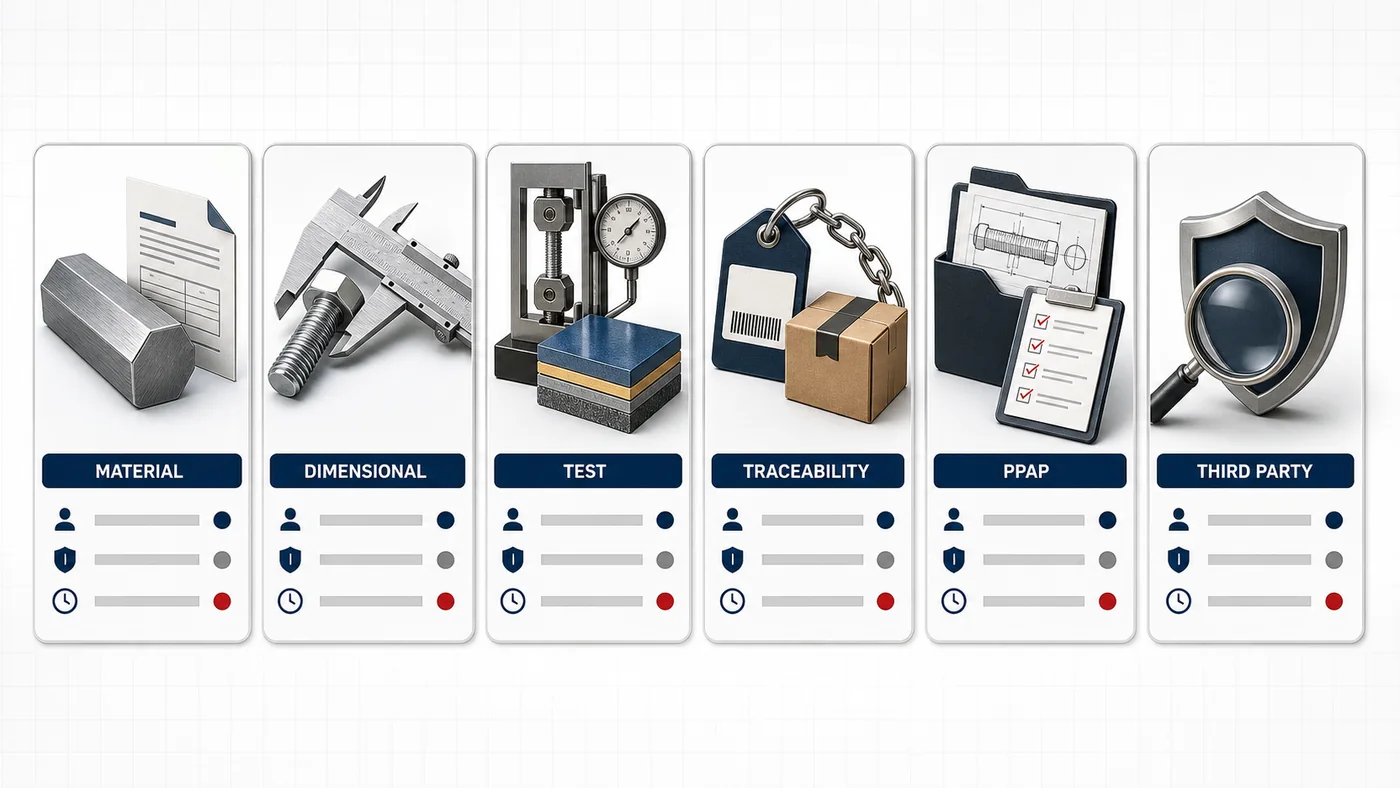
| Document or evidence | Typical purpose | Potential issuer | Define before order | Availability rule |
|---|---|---|---|---|
| Declaration or CoC | Declares conformity to an identified order or specification scope | Manufacturer or supplier, as contractually defined | Part, revision, standard, lot and declared scope | Confirm per product and order |
| Material test record or requested EN 10204 type | Reports specified source-material or ordered test information | Material producer, manufacturer or authorized inspection route, as applicable | Exact type, material specification, heat or lot link and required results | Confirm before quotation or order |
| Dimensional inspection report | Records agreed characteristics, tolerances and sample or lot results | Manufacturer or agreed inspection party | Drawing revision, characteristics, sampling and acceptance criteria | Confirm the inspection plan |
| Mechanical, performance or coating record | Reports specified tests, methods and results | Manufacturer, processor or laboratory route | Method, sample or lot, acceptance value and any accreditation requirement | Confirm method and facility |
| PPAP or customer submission | Supports customer approval for a defined part and process | Manufacturer package coordinated to customer requirements | Submission level, elements, timing and approval authority | Customer- and project-specific |
| Third-party inspection report | Records independent review against an agreed scope | Named or approved inspection body | Scope, witness or hold points, schedule and report format | Quote and schedule separately |
Fastener Material Records and Certificates of Conformity
Fastener material certificates and conformity declarations answer different questions. The exact title of a document matters less than its stated scope, issuer, traceability link and governing contractual requirement.
Material Test Records and EN 10204 Requests
A material test record reports the material or test information stated in that record. Where an EN 10204 document type is contractually requested, specify the exact type and confirm the issuer and validation route. Link the record to the relevant material heat, production lot or order when the governing requirement calls for that relationship.
Certificate of Conformity: Scope and Limitations
A Certificate of Conformity declares conformity to an identified order, drawing, standard or specification scope. It should identify the part and revision, relevant lot or order, declared requirement and issuer. A CoC is not a substitute for measured results when the order requires a dimensional, mechanical, coating or performance report.
What the Record Does Not Automatically Prove
A source-material record does not automatically demonstrate the finished fastener’s dimensions, heat-treatment condition, coating result, mechanical performance or suitability for the application. Match each required property to the governing specification, the agreed inspection method and a record that actually reports that property.
Fastener Inspection Documents and Reports
Fastener inspection reports should follow the ordered specification and agreed inspection plan. Every report should make the applicable part, revision, lot or sample, method and acceptance basis identifiable. Not every product or lot requires every test; the governing standard, drawing, customer requirement and order determine the scope.
Dimensional Inspection Reports
Define the controlled drawing or standard revision, characteristics to be measured, tolerances, sampling plan, units and result format. Dimensions that influence assembly or safety should be identified explicitly rather than left to a generic report request.
Mechanical and Performance Test Records
Specify the required test method, acceptance value, sample or lot relationship and any laboratory or accreditation condition. Mechanical-property reports, prevailing-torque data, fatigue evidence or application tests are only relevant when required by the applicable product or customer specification.
Coating, Corrosion and Process Records
State the coating system and specification, measured property, test method, acceptance target and any process evidence required. A coating description alone does not prove thickness, corrosion performance, friction behavior or hydrogen-embrittlement controls.
Match Each Requirement to Its Evidence and Acceptance Basis
Use this table to align each requirement with the evidence to request and its acceptance basis.
| Requirement | Evidence to request | Acceptance basis |
|---|---|---|
| Drawing or standard dimension | Dimensional inspection report | Stated tolerance, sampling and revision |
| Mechanical or functional property | Named test record | Applicable method and specified acceptance value |
| Coating or corrosion property | Coating, process or laboratory report | Finish specification and agreed test requirement |
Lot Traceability and Document Control
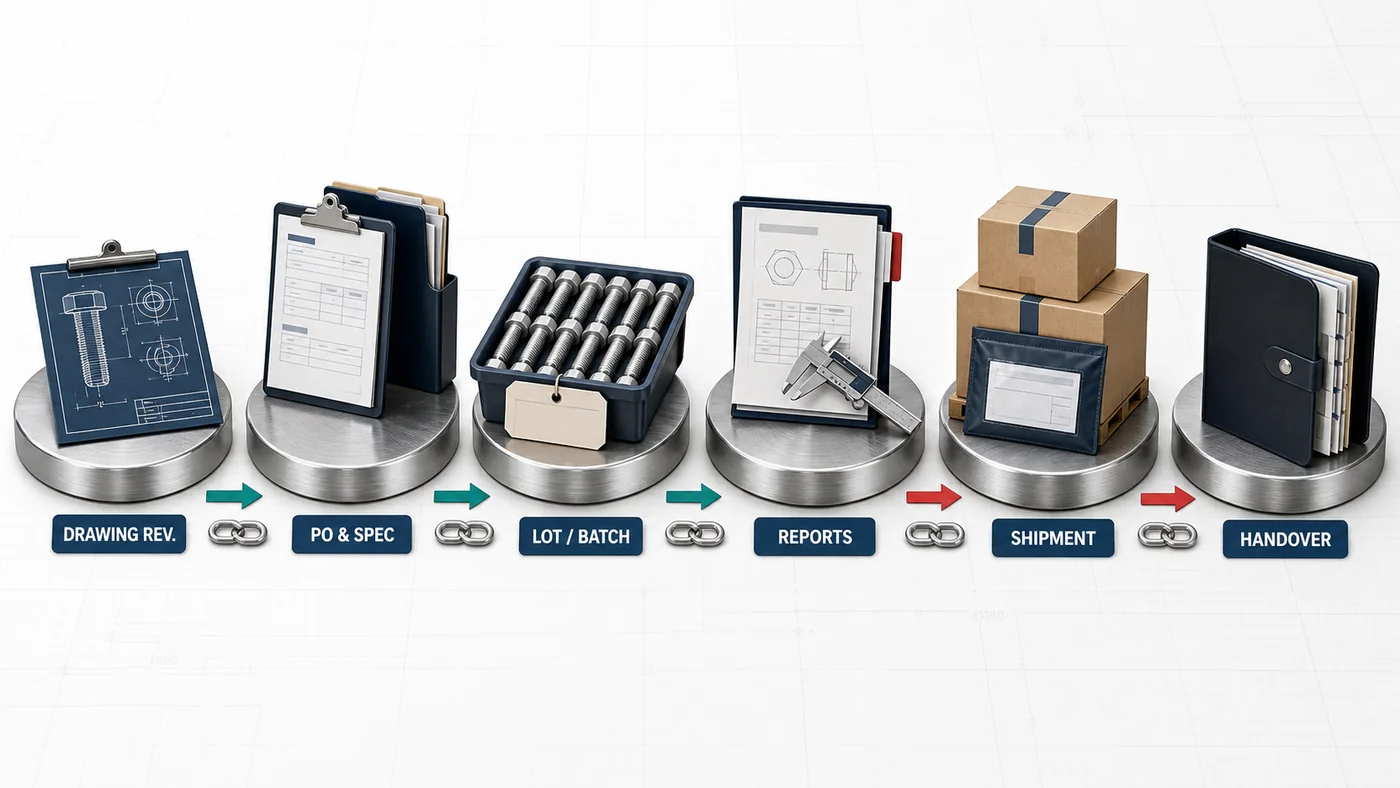
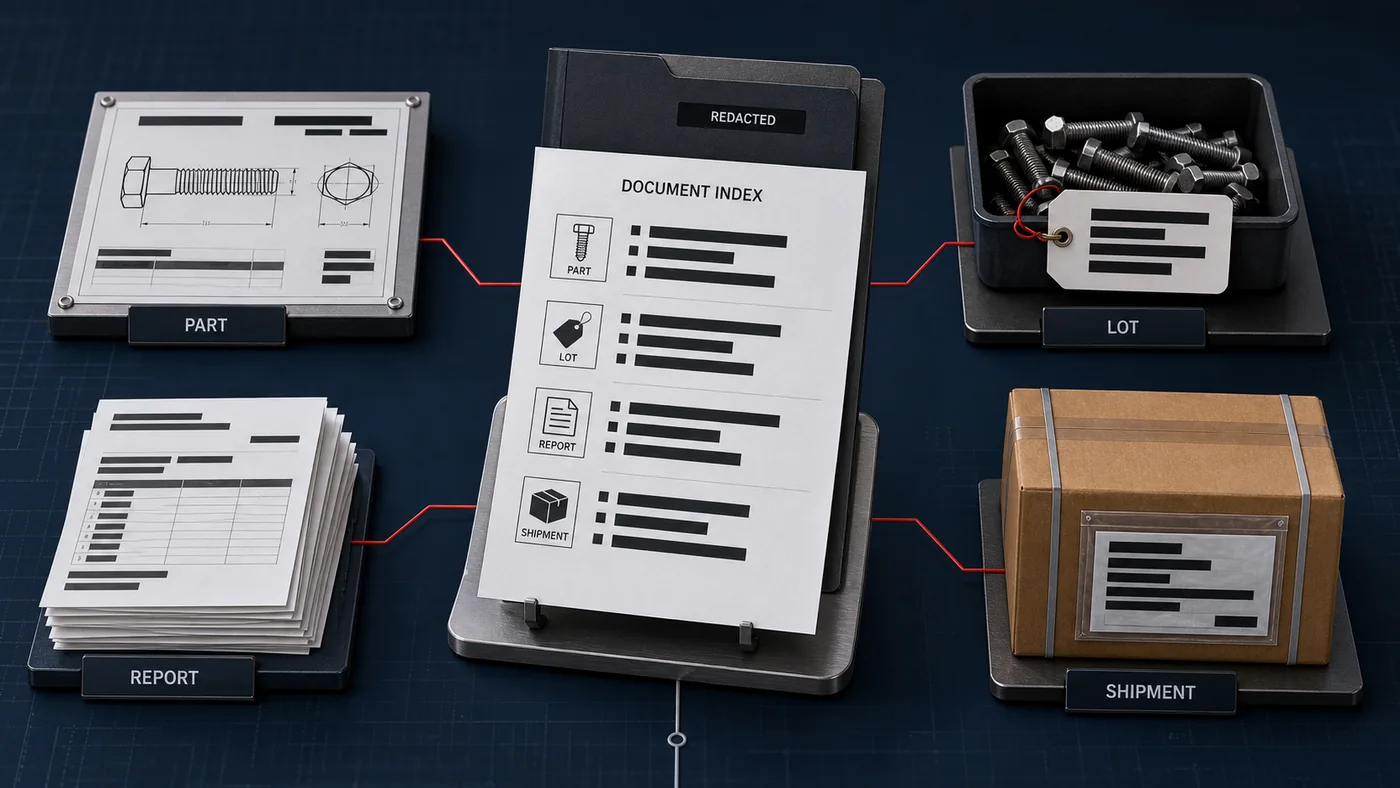
Fastener traceability documentation should connect the ordered part to the records delivered with the shipment. The desired chain runs from the buyer’s part or drawing revision through the purchase order and ordered specification, the manufacturer’s part and production lot, report identifiers and revisions, shipment references and the final document index.
Actual identifiers, retention periods, retrieval methods and traceability depth depend on the selected manufacturing route and order. Define the required identifiers and handover index during RFQ review; do not assume that a generic batch label provides every link required by the customer.
Connect the Part, Lot, Order and Report. Use consistent part, revision, order, lot and report references across the drawing, inspection records, packing documents and handover index. A change in drawing revision, lot or report revision should remain visible rather than being overwritten.
Revision, Retention and Handover Requirements. Agree the file naming, revision status, retention expectation, delivery format and recipient. Confirm which party controls the approved handover package and how superseded files are identified.
PPAP Support for Customer-Specific Fasteners
PPAP is a customer-defined submission and approval process, not a universal certificate. The AIAG PPAP reference describes the process used to demonstrate that engineering and specification requirements can be met consistently. The customer’s current requirement remains decisive.
Confirm the Required Level and Elements
Provide the customer or OEM requirement, controlled drawing revision, requested submission level, required elements, sample timing and approval authority. Fastener PPAP support, package content and availability are confirmed for the selected product and manufacturing route. Customer approval cannot be assumed from submission alone.
Initial-Sample, ISIR or FAIR Requirements When Specified
Initial-sample, ISIR or FAIR routes may be requested by a customer, but they are not interchangeable defaults. Name the required procedure, form, sample quantity, characteristics and acceptance authority in the RFQ.
Third-Party Fastener Inspection Coordination
Third-party fastener inspection can be reviewed when the RFQ identifies an agreed independent inspection body or customer-approval rule. Define the inspection scope, document review, sampling, witness or hold points, location, timing, language, report format and release authority before production or shipment. Availability, cost and schedule are confirmed for the specific project rather than promised as a standard inclusion.
Define Scope, Witness Points and Reporting Before Order
State which activities are to be witnessed, which records are reviewed, what stops work at a hold point and who authorizes release. Late additions can require a revised production or shipment plan.
How Documentation Is Confirmed and Delivered
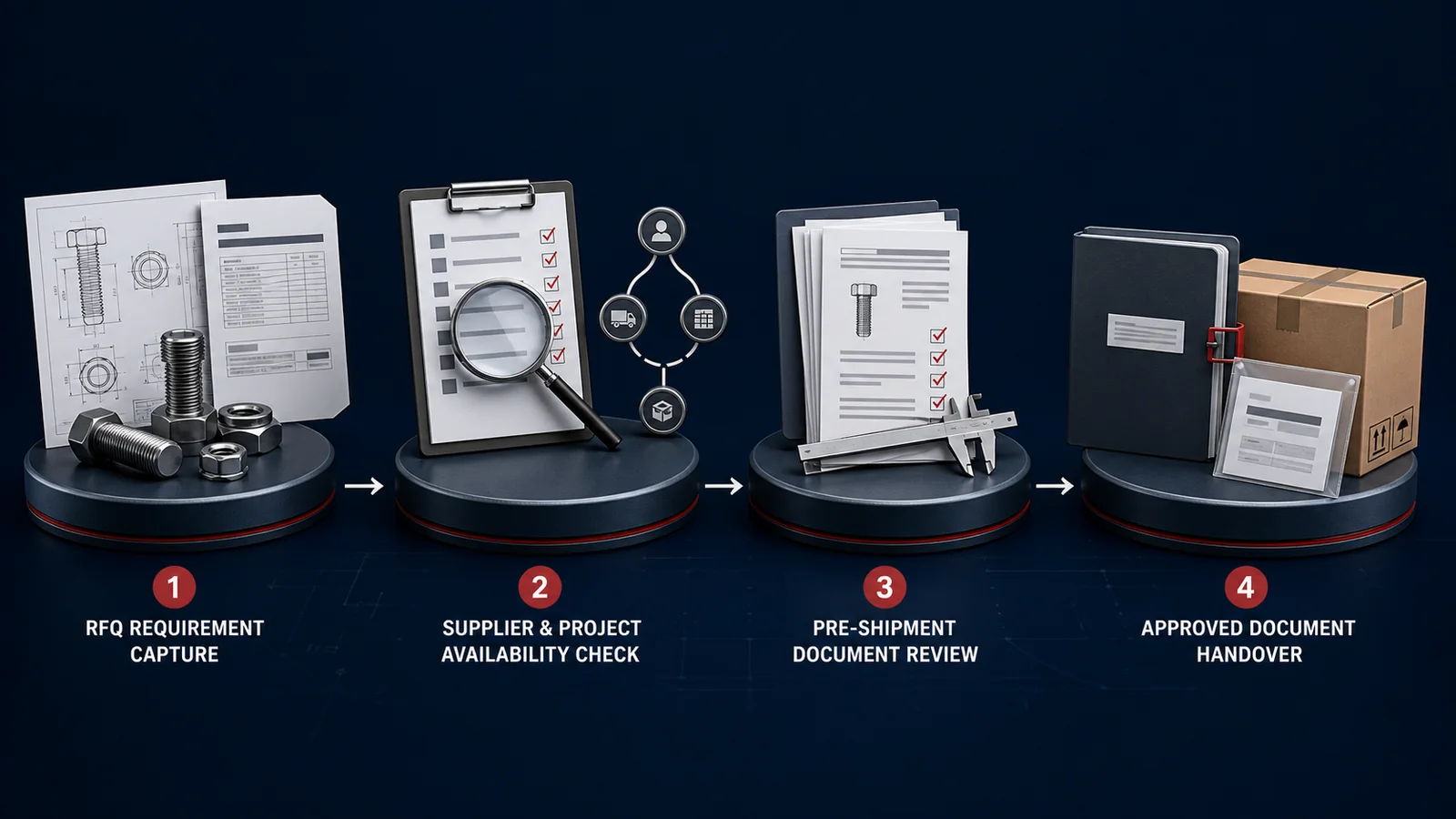
- 1
Requirement Capture
Send the product, drawing or standard, document list, acceptance criteria, quantity and destination. Missing or conflicting requirements are identified for clarification.
- 2
Order-Scope Availability Check
FastenersFromTurkey checks order-specific manufacturing capability, the expected issuer, test or inspection method, timing and commercial effect before confirming the quotation scope.
- 3
Pre-Shipment Document Review
Agreed records are checked against the order requirements and document index before the approved handover point. The exact review responsibility and acceptance authority remain defined by the contract and customer requirement.
- 4
Approved Handover Package
Files are delivered in the agreed language, format and timing with the approved report and shipment references. Changed or missing requirements return to clarification rather than being treated as automatically accepted.
Fastener Documentation RFQ Checklist
Include the following information so document availability and scope can be assessed:
| # | Include in the RFQ |
|---|---|
| 1 | Product, standard or controlled drawing and revision |
| 2 | Dimensions, thread, material or property class and coating |
| 3 | Application and customer or OEM requirement |
| 4 | Required document name, type, issuer and acceptance scope |
| 5 | PPAP level and elements or initial-sample requirement |
| 6 | Test method and acceptance criteria |
| 7 | Lot traceability, retention and handover requirements |
| 8 | Third-party inspection scope and witness or hold points |
| 9 | Language, format and delivery timing |
| 10 | Quantity, destination and target delivery date |
Fastener Quality Documentation FAQ
What Quality Documents Should I Request for Fasteners?
Request documents against the product, governing standard or drawing, material and property class, coating, lot traceability and customer requirements. The exact declaration, test report, inspection record or approval package should be agreed during RFQ review.
What Is the Difference Between a CoC and a Material Record?
A Certificate of Conformity declares conformity to an identified order or specification scope. A material record reports specified material or test information. Neither document should be treated as proof of requirements outside its stated scope.
Which PPAP Level Is Required?
The customer or OEM determines the PPAP submission level and required elements. Provide the customer requirement, drawing revision, sample timing and approval authority so availability and scope can be confirmed for the selected manufacturing route.
Can Third-Party Fastener Inspection Be Coordinated?
Third-party inspection can be reviewed when the RFQ defines the approved inspection body, scope, witness or hold points, timing and report format. Availability, cost and scheduling are confirmed for the specific project.
When Should Fastener Documents Be Requested?
Define required documents during the RFQ and confirm them before order placement. Late additions can change the manufacturing route, inspection plan, price or schedule and therefore require a new review.
Does an MTC Prove All Final-Fastener Properties?
No. A material test record demonstrates only the information and results within its stated scope. Final dimensions, heat-treatment condition, coating results, mechanical performance or application approval may require separate records under the governing specification.